J. L. BELL is a Massachusetts writer who specializes in (among other things) the start of the American Revolution in and around Boston. He is particularly interested in the experiences of children in 1765-75. He has published scholarly papers and popular articles for both children and adults. He was consultant for an episode of History Detectives, and contributed to a display at Minute Man National Historic Park.

Subscribe thru Follow.it


•••••••••••••••••


Showing posts with label Abigail Adams. Show all posts

Monday, August 10, 2026

Listening to Abigail Adams on Paper

A comment about yesterday’s quotation from Abigail Adams has prompted me to veer off into some linguistic digging.

Referring to Benjamin Davis, apparently notorious for taking gingerbread from refugees, Adams wrote: “How many little ones can say I was an Hungry & you gave me no Bread, but inhumanely took what little I had from me.”

The Massachusetts Historical Society shared a scan of this letter, so we can confirm she spelled the words that way.


As a minister’s daughter, Adams knew her Christian scripture. But she wasn’t quoting the King James Bible exactly. Matthew 25:42 says: “For I was an hungred, and ye gave me no meat:…” According to linguists, “an” was a form of the prefix “a,” as in “times’s a-wasting,” adapted to go before an H.

Adams instead used the form “an hungry,” which this linguistic website defines in its single-word form as “an obsolete word for hungry that is allowed to stay in Webster's Third New International Dictionary because it shows up in Shakespeare (Coriolanus I:i:209).” Did Adams misremember the Biblical verse? Or were people in the mid-1700s people reading the phrase that way?

Discussing Abigail Adams’s expressions leads me to Susan Walsh and Christopher S. Davis’s Adams Letters and Language podcast, hosted on YouTube. Walsh portrays Adams, along with being a librarian and educator. Davis is a historical dialect coach who studied 18th-century New England speech for the Boston Tea Party Ships & Museum.

On Saturday I heard their presentation at History Camp Boston, which will become a future podcast episode. Each episode includes a reading of John and Abigail Adams’s in period style “as well as discussion of the history, themes, and linguistics revealed by the letters.”

Since I’ve been impressionistically opining on how people really spoke in Revolutionary America since 2008, I look forward to hearing a more expert discussion.

Sunday, August 09, 2026

“The Women from the Windows asking Davis whether he wanted any Gingerbread”

Massachusetts ships captured the Peggy on its voyage from Halifax to New York on 22 July 1776, as described yesterday.

The civilians aboard that ship were taken to Marblehead, then to Boston under guard. Word spread quickly that one of them was Benjamin Davis, a merchant who had left town months before.

On 28 July, Joseph Ward wrote to John Adams from Boston about the ship: “There are many Tories on board, among whom is the noted Benjamin Davis.”

The next day, Ezekiel Price put in his diary: “Brought to town Benjamin Davis and a number of other Tories, who were committed to jail.”

Why was Davis being singled out? He’d made himself notorious in some way, and we have a couple of hints about how.

David Cobb wrote to Robert Treat Paine on 29 July:
Just now the Tories were Landed at the Long Wharf from Marblehead & were attended from thence to the Prison by 2 thousand people; the Women from the Windows asking Davis whether he wanted any Gingerbread, refering to his treatment of the little Chreldren when they were going out of Town last Year. I wish the Devil had ’em.
Abigail Adams alluded to the same scuttlebut in her letter to John the same day:
we have taken a vessel from Halifax bound to New York, which we should call a prize but that it containd about 14 Tories among whom is that infamous Wretch of a Ben Davis the Ginger Bread Robber. How many little ones can say I was an Hungry and you gave me no Bread, but inhumanely took what little I had from me. I wish the Sea or any other Element had them rather than we should be tormented with them.
The editors of the Adams and Paine Papers weren’t sure what to make of those remarks about gingerbread.

I can’t find any sources providing a definite answer, but here’s my guess. At the start of the war, many families sought to leave Boston. Gen. Thomas Gage didn’t want refugees to take out food, which his army needed, or weapons, which the provincial army needed. So the governor set up a system of passes and inspections using both military and civilian administrators.

In the 5 June 1775 Boston Gazette, Benjamin Edes published an open letter addressed “To the perfidious, the truce breaking THOMAS GAGE” and signed “Massachusettensis.” (This was not, presumably, the Loyalist political writer.) Among its complaints about Gage was:
Nay, have not you, and your associates by your orders, been mean enough to steal rum and sugar from a poor teamster, half a cake of gingerbread, a nutmeg, and half a bisket from a poor woman who was flying half famished out of Boston from your low lived tyranny and oppression?
That item was reprinted in several other Massachusetts and Connecticut newspapers over the next couple of weeks. It’s the one gingerbread-related complaint I could find from the period.

That complaint shows that people working for the royal government were confiscating food from folks trying to leave Boston, even mundane food like gingerbread, even from “a poor woman.”

I suspect that Benjamin Davis had agreed to work for Gage’s royal government as some sort of inspector or administrator. At some point that spring, he took gingerbread from a family or two trying to leave town. Children may have cried. That incident didn’t get into the newspapers, but it made him notorious enough that citizens yelled at “Ben Davis the Ginger Bread Robber” more than a year later.

And, unlike Hopestill Capen, few people in Boston minded seeing Davis locked up.

(The picture above shows the Pennsylvania politician Joseph Galloway, not mentioned anywhere in this posting. In September 1774 John Adams wrote in his diary that he was “introduced to Mr. Galloway, the Speaker of the House in Pensylvania. He looks like Ben. Davis the Sandimanian.”)

Saturday, July 18, 2026

“To hear the proclamation for independance read and proclamed”

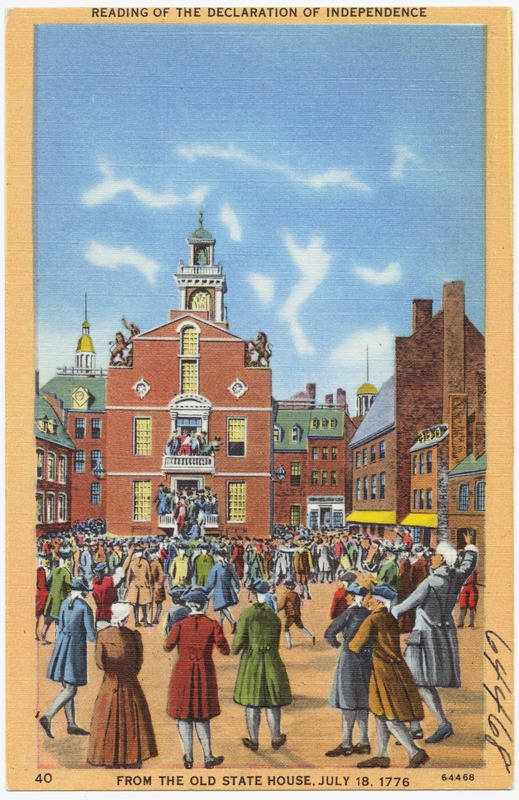
On 18 July 1776, 250 years ago today, the Declaration of Independence was officially proclaimed in Massachusetts.

People had already heard about the Continental Congress’s vote, and many had probably read the Declaration in newspapers. But this was a governmental ceremony. It happened in two places, and on two levels.

With no governor, the highest executive authority in Massachusetts was the Council. Most of its members were meeting in the Edmund Fowle house in Watertown.

Therefore, one part of the official reading was performed by Council secretary Perez Morton, reading the Declaration to the Council and to a crowd gathered outside. Also present were delegates from the Mi’kmaq and St. John’s/Maliseet communities, ready to sign a treaty of friendship with this new United States.

In Boston, there was a parallel, larger ceremony. Inside the Council’s chamber in what was now the State House, Suffolk County sheriff William Greenleaf read the Declaration to some Council members and other officials.

Col. Thomas Crafts of the Massachusetts artillery regiment, who had a bellowing voice, then “deaconed” or repeated the text phrase by phrase from the balcony of the Council chamber to the crowd gathered on the street below.

Thus, most Bostonians at the event heard Col. Crafts’s reading, but the official proclamation in Boston came from Sheriff Greenleaf. The ceremony was meant for both government officials and the “people out of doors.”

On 21 July, Abigail Adams reported to her husband:
Last Thursday after hearing a very Good Sermon I went with the Multitude into Kings Street to hear the proclamation for independance read and proclamed. Some Field peices with the Train were brought there, the troops appeard under Arms and all the inhabitants assembled there (the small pox prevented many thousand from the Country).

When Col. Crafts read from the Belcona of the State House the Proclamation, great attention was given to every word. As soon as he ended, the cry from the Belcona, was God Save our American States and then 3 cheers which rended the air, the Bells rang, the privateers fired, the forts and Batteries, the cannon were discharged, the platoons followed and every face appeard joyfull.

Mr. [James] Bowdoin [a senior member of the Council] then gave a Sentiment, Stability and perpetuity to American independance.

After dinner the kings arms were taken down from the State House and every vestage of him from every place in which it appeard and burnt in King Street. Thus ends royall Authority in this State, and all the people shall say Amen.
Not everyone was entirely pleased. Merchant John Rowe characterized the celebration as “a Great Confusion in Town.”

Pulling the royal emblems of the lion and unicorn down from the State House roof was probably inspired by reports of New Yorkers toppling the statue of King George III after that city’s reading of the Declaration on 9 July. But the street was still called King Street until 1784.

Friday, June 26, 2026

Celebrating the Sestercentennial at Adams National Historical Park

Adams National Historical Park will host a full week of events commemorating the Sestercentennial of the Declaration of Independence, which John Adams had a little something to do with.

Unless otherwise noted, all these events will take place on the grounds of the Old House at Peace field, located at 135 Adams Street in Quincy.

Friday, 26 June, 6 P.M.
Slice of History
A night of pizza and rewatching the animated cartoon Liberty’s Kids. This event is intended for viewers ages 18–30, who might enjoy memories of the original broadcasts, but all are welcome.

Saturday, 27 June, and Sunday, 28 June
The Adamses and the American Revolution
Adams Farm at Penn’s Hill, 141 Adams Street
Ranger talks and special programs sharing the experiences of the Adams family during the American Revolution and their contributions to American independence.

Sunday, 28 June, 4 P.M.
Jefferson & Adams
This stage play by Howard Ginsberg dramatizes the friendship between John Adams, Thomas Jefferson, and Abigail Adams. Actors Bill Barker, Sam Goodyear, and Abigail Schumann bring to life the fifty-year relationship—often contentious, sometimes turbulent, and ultimately enduring.

Tuesday, 30 June, 6 P.M.
My Dearest Friend
Written by Peter Manos, this play reveals the American Revolution and the founding of the United States through the rich, witty, and passionate correspondence between Abigail and John Adams. They spent years apart, sometimes on separate continents, but stayed intensely in love for more than half a century.

Wednesday, 1 July, 10 A.M. to 4 P.M.
Stories of the American Revolution
Learn more about the many stories of the American Revolution through ranger talks and special programs.

Wednesday, 1 July, 6 P.M.
Quincy’s Women on the Page
Novelists Stephanie Dray, Laura Kamoie, and Jodi Daynard share their experiences bringing Quincy women, including Abigail Adams, to life through historical fiction.

Thursday, 2 July, 11 A.M., 1 and 3 P.M.
Independence Forever: The Continental Congress
Become a delegate to the Second Continental Congress and re-enact the passage of the Declaration of Independence. This interactive event is an invitation to adults and children to take part in the debate about whether to remain loyal to the British crown or to create a new nation.

Friday, 3 July, 11 A.M., 1 and 3 P.M.
John and Abigail Adams
The couple share their experiences during the American Revolution. Music by the Conchords at noon and 2 P.M.

Saturday, 4 July, 11 A.M., 1 and 3 P.M.
Readings of the Declaration of Independence
Lend your voice to these live public readings of the Declaration of Independence 250 years after it was adopted. The afternoon readings will be held at the Adams Farm at Penn’s Hill, the Adamses’ home during the American Revolution.

Sunday, 5 July, 10 A.M. to 4 P.M.
Stories of the American Revolution
Learn more about the many stories of the American Revolution through ranger talks and special programs.

These special programs are all free to attend and don’t require reservations. Parking is at the Visitor Center at 1250 Hancock Street, half a mile away. Also half a mile away is the Quincy Center station on the M.B.T.A. Red Line. Events may be modified or cancelled due to especially hot or stormy weather.

Tuesday, June 16, 2026

Act Worthy of Yourselves at King’s Chapel, 18–20 June

King’s Chapel has brought back Act Worthy of Yourselves, a sixty-minute drama set around the funeral of Dr. Joseph Warren in April 1776.

The teaser copy says:
The British army has finally left Boston. Now, nearly a year after his death, friends and family can finally hold a funeral for Dr. Joseph Warren.

Inside King’s Chapel, his brother, his fiancée, and his good friend Paul Revere gather to mourn Warren and to make sense of their loss. Outside the Chapel, two Black abolitionists wonder what this revolution will mean for them. A play about memory, legacy, and the potential and pitfalls of the American Revolution.
While anchored in April 1776, the play flashes back to episodes in the life of Dr. Warren earlier in the 1770s. In addition to the doctor’s brother John and his fiancée, Mercy Scollay, the characters include the black businessmen Lancaster Hill and Prince Hall, Paul and Rachel Revere, Abigail Adams, merchant and Freemason John Rowe, medical trainee William Eustis, rising young lawyer Perez Morton, and Christopher Monk, badly wounded at the Boston Massacre.

This play was written by Noah Good and Kaitlin Rose, and directed by Anjie Echemendia. With that large cast and many scenes set at different times and places, it’s a complex undertaking. Last year, as I recall, many of the performers came from the King’s Chapel interpretive staff rather than Boston’s professional theatrical scene.

The remaining performances for this year are on 18–20 June at 7:30 P.M. and on Saturday, 20 June, at 2:00 P.M. Tickets cost from $40 to $15 depending on the view, and are available through this website.

Wednesday, May 13, 2026

“Stimuli to induce him to be useful to this Country”

One of the questions asked after yesterday’s talk on young Benjamin Thompson’s life in America was whether he interacted with any representatives of the U.S. of A. during his European career.

For example, did the former Woburn farmboy, royal government undersecretary, and British cavalry officer cross paths with John Adams, minister to Britain in the 1780s?

It appears that the two men never met since the first letters they exchanged, in 1796, show no personal acquaintance. By then Thompson had become the celebrated Count Rumford, and he was sending Adams a volume of his scientific papers and a large sum to endow a prize through the American Academy of Arts and Sciences. Rumford continued sending volumes to Adams through the Rev. William Walter.

In 1799, Abigail Adams wrote of “Rumfording our Chimney’s, which I shall be for trying. I am persuaded half the expence of fuel may be saved, and Rooms kept equally warm.” The Woburn native had become famous enough to be a verb.

In 1820, John Adams sent off multiple letters pursuing the theory that “the late learned ingenious scientific public Spirited and benevolent Count Rumford” was a descendant of “the well known Rev. William Tompson of Braintree.” (He was not.)

But the most striking intersection between Rumford and Adams arose in June 1799, when Adams’s secretary of war, James McHenry, wrote about inducing the count to offer his talents to the U.S. Army:
I think it was mentioned to you, some time last winter, by the Secretary of State [Timothy Pickering], in consequence of a letter he had just received from Mr. [Rufus] King [minister to Britain 1796–1803 and 1825–26], that Count Rumford intended to visit his native country, at which you seemed pleased, and expressed yourself favourably of his talents.

Mr. King has renewed the subject to the Secretary of State, and in a letter to me, which I have the honour to inclose. As the reference of the subject to me, can only be meant so far as it respects the military department, I beg leave to submit for your consideration, whether it would not be to the advantage of the United States to make such a proposal to the Count, which if accepted, would ensure to the army the full benefits of his skill and experience.

There is still a vacancy of Lt. Colonel, to be filled for one of the Regiments of Artillerists & Engineers. . . .

1. He may be offered the vacant commission of Lt. Colonel and be made also Inspector of Artillery. Or if he prefers it. 2d. He may be invited to accept of the office of Engineer…

As I consider him to be less of an Engineer than an Artillerist, altho in this I may be mistaken I should think it most adviseable to give a preference to the first proposition. If he accepts of it, he can also superintend the establishment of a military academy which the laws so far contemplate, as to have made provision for books, instruments, and teachers.

At any rate, if the Count should refuse himself to either office, the offer cannot be otherwise than grateful, and if he wanted any stimuli to induce him to be useful to this Country, to the extent of his talents, it might have its effect.
Adams had no idea that back in 1775 Thompson had been slipping secret intelligence to Gen. Thomas Gage—a fact that would probably have changed his admiration for the man.

As for Rumford, it’s hard to imagine that a man who had administered an entire country in Europe could be swayed by the prospect of being a lieutenant colonel in America. He never did come back.

Monday, March 16, 2026

“Very lucky for us that we got possession of Nook Hill”

On 16 Mar 1776, 250 years ago today, Abigail Adams wrote from Braintree to her husband John in Philadelphia:
There has been no firing since Last twesday [12 March], till about 12 o clock last Night, when I was waked out of my sleep with a smart Cannonade which continued till nine o clock this morning, and prevented any further repose for me
That cannon fire from the north was prompted by the Continental Army moving again onto Nook’s Hill on the end of the Dorchester peninsula nearest Boston.

As related back here, the Continentals had started to fortify that strategic ground on 9 March, but the British artillery forced them back with the loss of four men. A few quiet days followed before Gen. George Washington became impatient with the speed of the British departure and ordered another try.

The next day, Adams was able to report more details she’d heard about the operation:
It was very lucky for us that we got possession of Nook Hill. They had placed their cannon so as to fire upon the Top of the Hill where they had observed our people marking out the Ground, but it was only to elude them for they began lower upon the Hill and nearer the Town. It was a very foggy dark evening and they had possession of the Hill six hours before a gun was fired, and when they did fire they over shot our people so that they were coverd before morning and not one man lost
Meanwhile, the British inside Boston would have been happy to be outside Boston. They were staying in town despite every effort to leave. On 15 March, Capt. John Barker wrote in his diary:
The Wind being fair at 12 oclock in the day, the Troops were order’d under Arms in order to embark; but after waiting some time returned to their Quarters, the Wind having shifted.
And then on the 16th: “Still detained by the Wind.”

Abigail Adams saw the new position on Nook’s Hill as forcing the British out: “the enemy no sooner discoverd [that fortification] than Bunker Hill [in Charlestown] was abandoned and every Man decamp’d as soon as he could.” But as with the entire siege, Gen. William Howe was responding to weather conditions as much as or more than his enemy’s maneuvers.

Sunday, November 09, 2025

“Let not that man be trusted who can voilate private faith”

The Massachusetts Whigs were flabbergasted by the evidence that Dr. Benjamin Church, Jr., was corresponding with someone behind enemy lines.

By the fall of 1775, those men had worked alongside Dr. Church for a decade. He had helped to compose instructions for representatives, correspondence to Whigs in Britain, and political verse for engravings.

The doctor had delivered the Massacre memorial oration in 1773. He had represented Boston in the Massachusetts Provincial Congress and then the General Court, serving on the most sensitive committees.

His fellow legislators had chosen Church to take important documents to the Continental Congress in Philadelphia, and then to escort Gen. George Washington across the state from Springfield. He was serving as the top doctor in the Continental Army.

Church’s erstwhile colleagues wrote to each other in astonishment.

One group of Massachusetts Patriots who didn’t express such surprise, however, were the Massachusetts Whigs’ wives.

Those women had noted Church’s habit of extramarital affairs, rumored as early as 1769. By 1774 he was maintaining a mistress outside of Boston. To other men’s wives, the doctor’s betrayal of Sarah Church made it easy to believe he’d betrayed his political movement as well.

Abigail Adams wrote to her husband John on October 9:
You have doubtless heard of the viliny of one who has professd himself a patriot, but let not that man be trusted who can voilate private faith, and cancel solem covanants, who can leap over moral law, and laugh at christianity.
Mercy Warren, wife of Massachusetts house speaker James Warren, added her voice three days later:
I fear a Late Instance of perfidy and Baseness in one who Rancked Himself among the Friends to the Rights of society and the Happiness of the Community Will occasion many Inviduous Reflections from the Enemies of the American Cause.

I was Ever sorry that there should be one among the Band of patriots Whose Moral Character was Impeachable for when the Heart is Contaminated, and the Obligations of private Life Broken through, And the man has thrown of[f] the Restraints Both of Honour and Conscience with Regard to His own Domestic Conduct, what Dependance is to be Made on the Rectitude of His public Intentions.
Abigail Greenleaf, wife of the publisher Joseph Greenleaf, wrote to her brother Robert Treat Paine on 14 October:
How Sir, did you receive the news of the Perfidy & treachery of Docter Church? Was it not in Silent astonishment? It will I believe, bow down the grey hairs of his Father & Mother, with Sorrow to the grave. His Poor wife too, is an object of the Pitty, & Compassion of every one. She still Loves him, tho, he has treated her in so base a manner. If she looses her senses I think twill not be strange; but it will be melancholy.
Abigail Adams came back to the topic on 21 October:
What are your thoughts with regard to Dr. Church? Had you much knowledg of him? I think you had no intimate acquaintance with him.

“A foe to God was ne’er true Friend to man
Some sinister intent taints all he does.”
The wise response to such questions from a spouse was of course: ‘I agree with you, dear. I barely knew the man. You’re so right.’

Thursday, October 09, 2025

“Remember the Ladies” Conference in London, May 2026

The Benjamin Franklin House in London has issued a call for papers for a conference on “Remember the ladies”: Women and Revolution, to be held there…well, sometime in May 2026.

The invitation says:
In March of 1776, Abigail Adams wrote to her husband, advising him to “Remember the Ladies, and be more generous and favourable to them than your ancestors.” An eighteenth-century woman, – albeit a woman of relative means – Abigail witnessed first-hand acts of resistance great and small performed by the women of her generation. She stressed that women, like the men who sacrificed alongside them during the American Revolution, were not only deserving of fair laws that promoted equality, but also that her sex was more than capable of fomenting revolution in the face of marginalisation.

Yet, while women have historically played vital roles in revolutionary processes, their social, political, cultural, and intellectual contributions remain overlooked and undervalued.

We mythologise the infamous ride of Paul Revere, but little is known about the story of Sybil Ludington. When Jean-Paul Marat was assassinated for his fierce written tracts, he was viewed as a martyr; yet, Olympe de Gouges was sentenced to death for demanding equal rights for women and people of colour. The historical record is ripe with accounts of how Toussaint Louverture inspired the people of Saint-Domingue and transformed a burgeoning rebellion into a full-fledged revolution, but we less frequently hear about Cécile Fatiman and the immense courage she instilled in the enslaved people of Haiti as both a revolutionary and a priestess.

This conference aims to highlight the legacies of women whose lives were uniquely shaped by resistance, not just during the age of revolution, but also in more modern social movements.

Dr Megan King (Public Engagement Manager, Benjamin Franklin House), who specialises in eighteenth-century radicalisation and mobilisation, will spearhead a program of keynote speakers, paper presentations, and 10-minute ‘lightning talks’ to unpack works in progress. We welcome submissions from a range of research interests and disciplinary perspectives, and we particularly invite submissions from PGR students, ECRs, and those employed in the heritage sector.
Jargon translations: “PGR” means post-graduate students, or what we call grad students; “ECRs” are early career researchers; and “the heritage sector” means museums, historic sites, archives, conservation, and public history.

Dr. King invites scholars to email abstracts of no more than 500 words to supervisor@benjaminfranklinhouse.org by 10 Nov 2025.

Monday, September 08, 2025

“Our House is an hospital in every part”

On 8 Sept 1775, 250 years ago today, Abigail Adams had serious news for her husband John, who was heading back to the Continental Congress:
Since you left me I have passed thro great distress both of Body and mind; and whether greater is to be my portion Heaven only knows. You may remember [hired boy] Isaac [Copeland] was unwell when you went from home. His Disorder increasd till a voilent Dysentery was the consequence of his complaints, there was no resting place in the House for his terible Groans. He continued in this state near a week when his Disorder abated, and we have now hopes of his recovery.

Two days after he was sick, I was seaz’d with the same disorder in a voilent manner. Had I known you was at Watertown I should have sent Bracket [a farm hand] for you. I sufferd greatly betwen my inclination to have you return, and my fear of sending least you should be a partaker of the common calamity. After 3 day[s] an abatement of my disease relieved me from that anxiety.

The next person in the same week was [servant girl] Susy. She we carried home, hope she will not be very bad.

Our Little Tommy [Thomas Boylston Adams] was the next, and he lies very ill now—there is no abatement at present of his disorder. I hope he is not dangerous.

Yesterday [servant girl] Patty was seazd and took a puke. Our House is an hospital in every part, and what with my own weakness and distress of mind for my family I have been unhappy enough.
The Adams Papers editors noted: “Patty, who was probably a relative of JA or AA and had lived four years in the Adams household, died after a protracted and grisly illness early in October.”

The letter went on to list other neighbors who were ill. Abigail and John also both knew that his brother Elihu had died of the same disease in early August.

Two days later, Abigail resumed her letter:
As to my own Health I mend but very slowly—have been fearful of a return of my disorder to day but feel rather better now. Hope it is only oweing to my having been fatigued with looking after Tommy as he is unwilling any body but Mamma should do for him, and if he was I could not find any body that is worth having but what are taken up already with the sick. Tommy I hope is mending, his fever has abated, his Bowels are better, but was you to look in upon him you would not know him, from a hearty hale corn fed Boy, he is become pale lean and wan.

Isaac is getting better, but very slowly. Patty is very bad. We cannot keep any thing down that she takes, her situation is very dangerous. Mr. Trot and one of his children are taken with the disorder.
As discussed back here, George Trott was a politically active jeweler from Boston, and Abigail had taken in the Trott family as refugees.

The epidemic that Abigail’s letter described was “camp fever,” a bacterial dysentery. It spread among provincial soldiers and then to their families and neighbors because, basically, people didn’t yet realize they had to wash their hands and clothing thoroughly to avoid spreading germs. Women and servants caring for the sick thus became vectors for the disease to themselves or others.

All this time, Abigail was also worrying about smallpox, a viral disease that spread more slowly but was more deadly. She wrote:
The small pox in the natural way was never more mortal than this Distemper has proved in this and many neighbouring Towns. 18 have been buried since you left us in Mr. [Ezra] Welds parish [of Braintree]. 4, 3 and 2 funerals in a day for many days. Heitherto our family has been greatly favourd.
Looking ahead, Abigail asked John to send her medical supplies:
By the first safe conveyance be kind eno to send me 1 oz. of turkey Rhubub, the root, and to procure me 1 quarter lb. of nutmegs for which here I used to give 2.8 Lawful, 1 oz. cloves, 2 of cinnamon. You may send me only a few of the nutmegs till Bass [another family servant] returns. I should be glad of 1 oz. of Indian root. So much sickness has occasiond a scarcity of Medicine.
Many modern American parents can easily sympathize with Abigail having to care for a child like Tommy. But the number of sick people in the household and the neighborhood, and the specters of serious illness and death, are worries we’ve usually been spared. This sort of document is a reminder of the danger of rolling back proven health measures.

Tuesday, May 27, 2025

“Surely the most ridiculous expedition that ever was plan’d”

After the exchange of fire over Grape Island on 21 May 1775, both sides of the war claimed to have damaged the other and gotten the best of the day.

Four days after the fighting, the New-England Chronicle stated:
Whether any of the Enemy were wounded, is uncertain, though it is reported three of them were. It is thought that they did not carry off more than one or two tons of hay.
As for the gunfire from the departing Royal Navy vessels, that was “without effect.”

The next day’s Connecticut Gazette was even more positive:
the People…wounded 3 of the Enemy, and drove them off. They had got a Ton and Half of Hay on Board.
And the 3 June Pennsylvania Ledger said:
the regulars returned to Boston, with the loss of eight men killed and several wounded, as the provincials were informed by a gentleman that left Boston the next day.
In contrast, Lt. John Barker of His Majesty’s 4th Regiment wrote in his diary that ”a few of the Rebels were killed, without any loss on our side,” and he estimated the amount of hay removed as up to “7 or 8 Tons.”

Militaries always have a better sense of their own losses and usually exaggerate the enemy’s. If we follow that guideline and accept only what each army said about its own force, then the day ended without any casualties on either side.

The Crown forces had taken away a few tons of needed hay, but the Patriots burned far more—even Barker guessed his comrades had left “about 70” tons behind.

The provincials also burned Elisha Leavitt’s barn on the island. Local tradition held that he treated his neighbors to rum during the day to avert similar violence against his property on shore.

As usual, Lt. Barker saw a lot to complain about:
It was surely the most ridiculous expedition that ever was plan’d, for there were not a tenth part boats enough even if there had been Men enough, and the Sloop which carried the Party mounted 12 guns, but they were taken out to make room, whereas if one of two had been left it would have effectually kept off the Rebels
That might have been echoed in the 26 May Connecticut Gazette: “We hear Gen. [Thomas] Gage blamed the Admiral [Samuel Graves] for sending Vessels that were so small, on this Enterprize.” We should ask how the printers could reliably know such a thing. On the other hand, it may be significant that Graves skipped over this action in his self-serving report narrative of the war.

The reaction on the provincial side was very different. In a follow-up letter to her husband, Abigail Adams had nothing but praise for the locals who took part in the fight, particularly their own relatives:
I may say with truth all Weymouth Braintree Hingham who were able to bear Arms, and hundreds from other Towns within 20 30 and 40 miles of Weymouth.

Our good Friend the Doctor [Cotton Tufts] is in a very misirable state of Health, has the jaundice to a [very gr]eat degree, is a mere Skelliton and hardly able to [ride fro]m his own house to my fathers. Danger you [know] sometimes makes timid men bold. He stood that day very well, and generously attended with drink, Bisquit, flints &c. 5 hundred men without taking any pay. He has since been chosen one of the committee of Correspondence for that Town, and has done much Service by establishing a regular method of alarm from Town to Town.

Both your Brothers were there—your younger Brother [Elihu Adams] with his company who gaind honour by their good order that Day. He was one of the first to venture aboard a Schooner to land upon the Island.
That reflects the general mood on the two sides at this time. The British military was having inter-service quarrels over logistics while the provincials were celebrating solidarity. Even though neither side had accomplished a great deal, or suffered a serious loss.

Monday, May 26, 2025

“Assembled on a Point of Land next to Grape-Island”

Yesterday we left the people of Weymouth and surrounding towns in a panic as three or four vessels full of British soldiers appeared off their north coast early on Sunday, 21 May 1775.

Abigail Adams happened to be writing on her husband’s behalf to Edward Dilly, a British publisher and bookseller sympathetic to the American Whigs. She portrayed the situation like this:
Now this very day, and whilst I set writing the Soldiers provincial are passing my windows upon an allarm from the British troops who have been landing a number of Men upon one of our Sea coasts (about 4 miles from my own habitation) and plundering hay and cattle. Each party are now in actual engagement. God alone knows the Event, to whom also all our injuries and oppressions are known and to whom we can appeal for the justice of our cause when the Ear of Man is deaf and his heart hardned.
At the command of Lt. Thomas Innis of the 43rd Regiment, scores of those redcoats started coming ashore, carrying long, sharp…scythes. They got to work harvesting hay from Grape Island, to take back to Boston to feed the garrison’s horses.

Meanwhile, local militia companies gathered in the towns, eventually augmented by three companies from the provincial army camp at Roxbury. An 1893 Hingham town history assumed that Capt. James Lincoln, commander of a new company of Massachusetts troops, took charge. That history stated: “The old people of fifty years ago, used to tell of the march of the military down Broad Cove Lane, now Lincoln Street.”

Once those local men reached the shoreline, however, they discovered that there was little they could do. As the 25 May New-England Chronicle reported:
The People of Weymouth assembled on a Point of Land next to Grape-Island. The Distance from Weymouth Shore to the said Island was too great for small Arms to do much Execution; nevertheless our People frequently fired.

The Fire was returned from one of the Vessels with swivel Guns; but the Shot passed over our Heads, and did no Mischief.

Matters continued in this State for several Hours, the Soldiers polling the Hay down to the Water-Side, our People firing at the Vessel, and they now and then discharging swivel Guns.
In Scituate, Paul Litchfield recorded in his diary, the Rev. Ebenezer Grosvenor went ahead with the second part of his Sunday sermon as normal.

Eventually the tide came in. Abigail Adams wrote of the shoreline defenders:
At last they musterd a Lighter, and a Sloop from Hingham which had six port holes. Our men eagerly jumpt on board, and put of for the Island. As soon as they [the regulars] perceived it, they decamped. Our people landed upon [the] Island, and in an instant set fire to the Hay which with the Barn was soon consumed, about 80 ton tis said.
The newspaper report offered more details:
The Tide had now come in, and several Lighters, which were aground, were got afloat, upon which our People, who were ardent for Battle, got on board, hoisted Sail, and bore directly down upon the nearest Point of the Island.

The Soldiers and Sailors immediately left the Barn, and made for their Boats, and put off from one End of the Island, whilst our People landed on the other. The Sloops hoisted Sail with all possible Expedition, whilst our People set Fire to the Barn, and burnt 70 or 80 Tons of Hay; then fired several Tons which had been polled down to the Water-Side, and brought off the Cattle.
Lt. John Barker basically agreed with that sequence of events in his diary:
as soon as they [the foragers] landed they were fired on from the opposite shore but without receiving any harm, the distance being too great; the party did not return the fire but kept on carrying the hay to the boats, until at last the Rebels in great numbers got into Vessels and Boats and went off for the Island; the party then embarked and sailed off with what hay they had, and as they were obliged to go along shore they were fired upon, when Lt. Innis who commanded was at last forced to return the fire…
Back to the New-England Chronicle:
As the Vessels passed Horse-Neck, a Sort of Promontory which extends from Germantown [in Braintree], they fired their Swivels and small Arms at our People very briskly, but without Effect, though one of the Bullets from their small Arms, which passed over our People, struck against a Stone with such Force as to take off a large Part of the Bullet.
That ended the crisis. All that remained was for the two sides to tote up gains and losses.

TOMORROW: The bottom line.

Sunday, May 25, 2025

“3 Sloops and one cutter had come out”

In May 1775, the people of Hingham and other towns along the South Shore from Boston weren’t really worrying about protecting livestock on harbor islands.

As a 3 May petition from selectmen in Braintree, Weymouth, and Hingham to the Massachusetts Provincial Congress put it, those towns felt “in great danger of an attack from the troops now in Boston, or from the ships in the harbor.”

They worried that the British military would attack the towns themselves, not off-shore pasturage—perhaps to seize food but mostly to punish the rebellious population.

The congress therefore authorized those towns to raise two and a half companies of men for their defense through the end of the year, on the same terms as the provincial soldiers being signed up to keep besieging Boston. In Hingham, James Lincoln took a captain’s commission and started recruiting.

On the morning of Sunday, 21 May, vessels were spotted maneuvering through the islands off the Weymouth shore. Abigail Adams described the response in north Braintree:
When I rose about six oclock I was told that the Drums had been some time beating and that 3 allarm Guns were fired, that Weymouth Bell had been ringing, and Mr. [Ezra] Welds [churchbell in Braintree’s middle precinct] was then ringing.

I immediatly sent of an express to know the occasion, and found the whole Town in confusion. 3 Sloops and one cutter had come out, and droped anchor just below Great Hill. It was difficult to tell their design, some supposed they were comeing to Germantown others to Weymouth. People women children from the Iron Works flocking down this Way—every woman and child above or from below my Fathers.

My Fathers family flying, the Drs. [Cotton Tufts’s] in great distress, as you may well immagine for my Aunt had her Bed thrown into a cart, into which she got herself, and orderd the boy to drive her of to Bridgwater which he did. The report was to them, that 300 hundred had landed, and were upon their march into Town.

The allarm flew [like] lightning, and men from all parts came flocking down till 2000 were collected
In Scituate, Paul Litchfield was home from Harvard College, his senior year cut short by the war. He wrote in his diary:
Just before meeting began in morning, hearing the King’s troops were landing near Hingham, the people in general dispersed, so no meeting.
The 25 May New England Chronicle, newly moved to Cambridge, reported this military response:
Last Sabbath about 10 o’clock A.M. an express arrived at General [John] Thomas’s quarters at Roxbury, informing him that four sloops (two of them armed) were sailed from Boston, to the south short of the bay, and that a number of soldiers were landing at Weymouth.

Gen. Thomas ordered three companies to march to the support of the inhabitants.
But the first newspaper report of the action was the 22 May Newport Mercury:
An express arrived here this morning, from Providence, with advice, that a party of soldiers from Boston had landed at Weymouth, and burnt the town down, and were ravaging the country when the express came away. Troops from all parts of the country were going to oppose them.——The particulars not yet come to hand.
TOMORROW: The particulars of what really happened.

Saturday, May 03, 2025

“Eads escaped out of town last night”

I got interested this week in how printers exited Boston around the start of the war because of a question from a Boston 1775 reader about Benjamin Edes.

The standard understanding of Edes’s departure goes back to the 1901 biography of his son, Peter Edes, Pioneer Printer in Maine. Samuel Lane Boardman wrote:
In the spring of 1775, the town of Boston being in possession of the British troops, Mr. Edes contrived to evade the vigilance of their guards and went to Watertown with an old press and one or two imperfect fonts of type. The escape was made by night in a boat up the Charles river.
We know Edes reestablished the Boston Gazette in Watertown on 5 June 1775, and the shortest distance between Boston and Watertown is indeed up the Charles River.

But Edes’s journey was more complicated than that. Let’s start with a letter from Peter Edes that Boardman reprinted later in his biography, the same letter that I quoted a couple of days ago in regard to the Tea Party.

Writing to a grandson in 1836, Peter Edes said his father:
made his escape by disguising himself as a fisherman, and getting on board a fishing boat; and when they were a few miles from town he was landed on one of the islands, from which he made his escape to the main land.
To escape from Boston on a fishing vessel and to land on an island meant heading out into the harbor or beyond, not up the Charles River.

That detail matches a couple of contemporary reports from south of Boston, both sent to John Adams.

First, on 7 May Abigail Adams told her husband:
Poor Eads escaped out of town last night with one Ayers in a small boat, and was fired upon, but got safe and came up to Braintree to day. His name it seems was upon the black list.
On the same day James Warren wrote to his friend:
By the way I have Just heard that Edes has stole out. I wish his partner was with him. I called on Mrs. Adams as I came along. Found her and Family well.
Thus, Benjamin Edes left Boston in disguise on the night of 6 May. He may have brought out printing equipment, though these early sources don’t say that. I’d love to identify “Ayers,” but I’m not even certain of that spelling.

Edes must have landed somewhere off the south shore, given how Patriots in Braintree heard about his arrival within a day. Did Warren tell Adams, or did Adams tell Warren?

Then Edes made his way back toward the siege lines, settling in Watertown to be close to the Massachusetts Provincial Congress, its news, and its printing jobs.

Edes’s partner, John Gill, didn’t get out of Boston. Instead, in the wake of the Battle of Bunker Hill he and the teen-aged Peter Edes were arrested and held in the Boston jail for several weeks.

COMING UP: Under one roof.

Sunday, March 16, 2025

“Phebe Oliphant (a Black woman)”

At the Eleven Names Project, Wayne William Tucker shared a long essay about the preferred names of the black woman who helped to raise Abigail Adams and was part of her household later in life.

As Abigail grew up and married, that woman was enslaved to her father, the Rev. William Smith, probably coming from the family of her mother, formerly Elizabeth Quincy. The Quincy and Smith families referred to her by her first name only: Phoebe.

After becoming free in 1783, Phoebe married a man whom Abigail referred to as “Mr. Abdee.” Seeking to treat her in the same way as white women, the Adams Papers editors therefore referred to her as Phoebe Abdee.

Following that lead, I’ve tagged her under the name Phoebe Abdee. So did Woody Holton in one of the few articles written about her.

Tucker has found a more complex story in local records, however, indicating that Phoebe did adopt her husbands’ surnames—but Abdee wasn’t one of them.

First, Tucker brings up the possibility that Phoebe married and had children while enslaved to the Smiths, based on mentions of other people in the accounts settling the minister’s estate in 1784. That’s just a possibility, though.

In 1777, the Rev. Mr. Smith read out an intention to marry for his “Phebe” and “Brester Sternzey of Boston.” There’s no confirmation this union went through. (Boston’s town records don’t mention this intention. They state that the Rev. Joseph Eckley married Bristol Stenser and Deborah Foster on 16 Dec 1784.)

In 1784, Phoebe married a man Abigail Adams identified as “Mr. Abdee whom you know.” His name appears in town records as Abdi and Abda, elsewhere as Abdy. Tucker connects this man to “Abde Deacon Savil’s negro man,” who had married a woman enslaved to a Braintree minister back in 1754. It appears that Abdee (however spelled) was his given name, and that after emancipation (if not before) he used Savil as his surname. This man died in the first week of 1798, according to Abigail’s sister Mary Cranch.

On 19 Sept 1799, Quincy vital records show a woman named Phebe Savil marrying William Olifant. A month later, John Adams mentioned that Phoebe had remarried. In 1800, Abigail referred to Phoebe’s husband as William for the first time.

Finally, on 7 Oct 1812, weeks after Abigail referred to Phoebe as “sick and dying,” the Quincy records state that “Phebe Oliphant (a Black woman”) died at age eighty-three.

As Tucker says, the coincidences of the dates strongly suggest that the Adamses were referring to Phebe Savil/Oliphant, the woman Abigail had known all her life, without using her surnames.

Thus, it appears that “Phoebe Abdee” went by:
  • Phebe as an enslaved woman, not by choice—her choice of surname, if any, unknown.
  • Phebe Savil from 1784 to 1799, after her husband Abdee.
  • Phebe Oliphant from 1799 to 1812, after her husband William.
This is a nice piece of research, supported by clips of the documents themselves, which helps to fill out a life we’ve known only through the Adams family.

Thursday, January 30, 2025

Lincoln’s Sestercentennial Series

The town of Lincoln is observing the Sestercentennial with a series of exhibits at the library and a series of events.

The January exhibit was about Lincoln’s vote to send delegates to the Massachusetts Provincial Congress 250 years ago this month. The February exhibit will be on the theme “Enslaved in the American Revolution.”

Here are the presentations and other events announced so far.

Thursday, 30 January, 7:00 P.M., online
Causes of the American Revolution
Dane Morrison

Increasing taxation created dissent in Massachusetts. In 1774, Great Britain issued more punitive measures to suppress dissent and restore order, such as the revocation of the Massachusetts Bay Colony Charter of 1691. Former Salem State Professor Dane Morrison will discuss Lincoln at the beginning of the Revolution, exploring why an inland agricultural village would feel threatened by the new royal and Parliamentary initiatives. Register here.

Sunday, 2 February, 12:30–4:00 P.M., in and around Bemis Hall
The Lincoln of 1775
Co-hosted by the Bemis Free Lecture Series, the Lincoln Historical Society, the Lincoln Minute Men, the Middlesex County 4-H Fife & Drum, and Lincoln250

What was life like for families 250 years ago in Lincoln? Talk with reenactors about the attire, the food, and the amusements of family life of the day. The event will include musket demonstrations and music. At 2:00 P.M., a dance party will begin with instruction for all who wish to join. Refreshments will be served.

Thursday, 27 February, 7:00 P.M., online
Entangled Lives, Black and White in Lincoln, Mass.
Don Hafner

In the 18th century, the town of Lincoln had dozens of Black residents, enslaved and free, who helped the town thrive. They plowed the fields, hoed the gardens, and harvested the food. They did the cooking, they did the laundry, they cared for the children, they tended the sick and the elderly. They worked the blacksmith shops and the sawmills, made the nails and cut the boards for Lincoln’s first meeting house and houses that still stand. More than a hundred white residents of Lincoln lived in a household with an enslaved person. Come hear what we know about their entangled lives with historian Don Hafner. Register here.

Saturday, 8 March, 2:00 P.M., at the library
Meet Abigail Adams
Sheryl Faye

Lincoln250 celebrates Women's History Month! All ages are invited to Sheryl Faye’s engaging portrayal of Abigail Adams, wife of second President John Adams and sister of Lincoln Minute Men captain William Smith. Ms. Faye will portray Abigail as an adult and a child as she navigates life in colonial New England and stands up for the rights of women during the turbulence of War for Independence. All ages welcome. No registration necessary.

Thursday, 13 March, 7:00 P.M., at the library
Women in the American Revolution
Audrey Stuck-Girard

While the experiences of individual women during the American War of Independence have been largely left out of the historical record, they were nonetheless active participants of the cultural shift known as the American Revolution. Rural Massachusetts women in 1775 managed household budgets and property while being legally barred from owning any of that property. As the primary influence and educators of young children, they instilled moral and cultural values and ethics to the first generation of independent Americans. And when many of the men in their lives were away serving or killed in the war, women endeavored (with varying levels of success) to fulfill both male and female roles in their absence. Register here.

Friday, January 03, 2025

A New Edition of The Power of Sympathy

As a self-proclaimed propagator of unabashed gossip from Revolutionary New England, I have to note the recent publication of a new edition of The Power of Sympathy.

William Hill Brown published this novel pseudonymously in 1789. Most readers quickly recognized that it was based on a recent sex scandal in the top echelon of Boston society: rising attorney Perez Morton had impregnated his wife Susan’s sister, Fanny Apthorp.

In 1787 that affair led to a baby and parental rejection. In 1788 came a challenge to a duel from a Royal Navy officer and months of newspaper innuendo. Finally, Fanny committed suicide. Brown’s novel presented her character sympathetically—but was the book another layer of scandal?

This edition has been assembled by Prof. Jennifer Harris at the University of Waterloo and Prof. Bryan Waterman at New York University. It includes not only Brown’s The Power of Sympathy but also his play Occurrences of the Times, exploring some of the same incident as farce, and another closet drama, Sans Souci, alias, Free and Easy, digging into the sensitive spots of upper-class Boston.

Appendices reprint Fanny Apthorp’s final letters, which circulated at the time, and her sister Sarah Wentworth Morton’s poems; newspaper coverage of the case; newspaper essays on the place of women in the new republic; and letters from Mercy Warren and Abigail Adams about proper behavior for young republican gentlemen.

(Early on, people speculated that Sarah Wentworth Morton herself had written The Power of Sympathy, and that Mercy Warren had written the San Souci play. Warren was exasperated by that suggestion, Morton probably humiliated. I find it significant that both women eventually discarded their early anonymity and published under their own names, establishing how they wanted to be remembered as writers.)

The publisher of this new edition, Broadview Press, is based in Ontario. The book appears to have been published in Canada last month, but is scheduled to officially appear in the U.S. of A. this summer.

Monday, October 07, 2024

Smith on Abigail Adams on C-SPAN

“I wish I could write to you, much oftener than I do,” John Adams assured his wife Abigail on this date in 1774. “I wish I could write to you, a Dozen Letters every day.”

Abigail’s last letter to John included news of Braintree stepping up its militia practice, a rumor about “a conspiracy of the Negroes,” and criticism of slavery as “a most iniquitious Scheme.”

In her next, she advised:
The People in the Co[untr]y begin to be very anxious for the congress to rise. They have no Idea of the Weighty Buisness you have to transact, and their Blood boils with indignation at the Hostile prepairations they are constant Witnesses of.
This period seems to have been when Abigail Adams started growing into John’s closest political advisor. Telling him about events in Massachusetts while he was away on government business emboldened her to include her own observations, and then opinions.

Because Abigail and John Adams were separated at many crucial periods, and they and their descendants carefully preserved their letters, we can see that relationship evolve. It’s likely that some other politicians’ wives were giving them advice, too. But with Abigail, we know she was.

C-SPAN has just posted the recording of a talk by John L. Smith, Jr., author of The Unexpected Abigail Adams, a biography published earlier this year.

Smith spoke this past June at the Fort Plain Museum’s American Revolutionary War 250 Conference. The museum also sells Smith’s book at a discount.

Wednesday, May 15, 2024

“Terminated in a Duel…at Dorchester Point”

While looking for more ties between Charles Miller and the Boston Patriots, I came across this story from the next generation.

Boston’s Constitutional Telegraphe newspaper reported on 17 June 1801:
We hear, and are concerned to state, as we conceive it a painful task, which we consider to be our duty to perform, to announce to the public an unfortunate dispute between Mr. Charles Miller, jun. and Mr. Edward Rand, both of this town, which terminated in a Duel, early on Sunday morning last, at Dorchester Point…
Charles Miller, Jr., was baptized in King’s Chapel on 18 Nov 1770. So far as I can tell, he was the first and only child of Charles Miller, a younger son of Braintree’s Anglican minister, and his first wife, Elizabeth Cary of Charlestown.

Charles, Jr., followed his father into the mercantile business. Around the turn of the century there are lots of advertisements in Boston papers for goods offered by the firm of “Charles Miller & Son.”

Edward Rand was baptized in Boston’s New North Meetinghouse on 22 Aug 1773. He was the fourth child of Dr. Isaac Rand, Jr., a physician suspected of being a Tory but mostly tolerated because of his medical skills. (Dr. Isaac Rand, Sr., was an active Patriot, caring for soldiers with smallpox during the siege of Boston.) By the end of the 1700s the younger Dr. Rand’s reputation was solid enough that he was elected president of the Massachusetts Medical Society.

In April 1800, Charles P. Phelps (1772–1857) and Edward Rand announced that together they had rented a large store on Codman’s Wharf to sell imported fabric, hardware, and spermaceti candles. They offered to advance cash on consignments and sought “a Lad about 14 years of age” to work for them.

A duel between rising young men from such prominent families was bound to cause talk. In a letter to her youngest, Abigail Adams said: “it is reported that the Quarrel arose about a Female— this is the first instance of the Kind in our State.” Massachusetts had seen some duels before, but not that many involving locals.

The item in the Green Mountain Patriot of Peacham, Vermont, on 2 July avoided using the term “duel,” saying instead that the two men had met “for the purpose of honorably settling an honorable dispute.”

The Federal Galaxy of Brattleboro broke the full story on 29 June:
FATAL DUEL.

A report of a late duel in Boston has been current in town for ten days past—A letter dated Boston, June 17, received by the Editor, from his friend residing there, gives the following recital of the event:

“Some misunderstanding having taken place between Messr. Charles Miller, jun. and Isaac [sic] Rand, (respectable merchants in Boston) which originated respecting a certain young lady, to whom Miller had paid his addresses; after giving each other some hard words, Rand sent Miller a challenge, which was accepted. Having agreed on seconds, they repaired to Dorchester Point early on Sunday morning last;…”
Decades later, Rand’s business partner Phelps wrote in an unpublished memoir that the lady was “from Rhode Island,” but I located no source identifying her.

After describing the action, the letter in the Federal Galaxy stated:
“You will find no mention made of this affair in the Boston papers, as the several printers have been requested by the parents of Miller and Rand, not to notice it.”
And indeed the Constitutional Telegraphe’s article appears to be the only report printed inside Boston. It was, however, reprinted outside the town from Maine to Virginia.

TOMORROW: Who lived, who died, who told the story.

Sunday, April 14, 2024

“We shall have many chearful rides together yet”

As I quoted yesterday, in his 6 Apr 1775 letter to his wife Mercy, James Warren started by telling her that the latest news from London made a political solution to Massachusetts’s conflict with the Crown less likely.

And that had kept the Massachusetts Provincial Congress in Concord from adjourning as he’d hoped.

Warren went on:
However my Spirits are by no means depressd, you well know my Sentiments of the Force of both Countrys, you know my opinion of the Justness of our Cause, you know my Confidence in a Righteous Providence. I seem to want nothing to keep up my Spirits and to Inspire me with a proper resolution to Act my part well in this difficult time but seeing you in Spirits, and knowing that they flow from the heart.

How shall I support myself if you suffer these Misfortunes to prey on your tender frame and Add to my difficulties an affliction too great to bear of itself. The Vertuous should be happy under all Circumstances. This state of things will last but a little while. I believe we shall have many chearful rides together yet.

We proposed last week a short adjournment and I had in a manner Engaged a Chamber here for my Beloved and pleased myself with the health and pleasure the Journey was to give her; but I believe it must be postponed till some Event takes place and changes the face of things.
There was deep affection between the Warrens, just as there was between their friends, John and Abigail Adams. At this time James was forty-eight years old, Mercy forty-six. They had five children, all boys; the youngest was George, who turned nine that year. Looks like James thought that was old enough for Mercy to come to Concord for some private time with him while the congress wasn’t in session.

At the end of his 6 April letter, James returned to that personal message for Mercy:
But to dismiss publick matters, let me ask how you do and how do my little Boys, especially my little Henry [second youngest, born in 1764], who was Complaining. I long to see you. I long to sit with you under our Vines etc and have none to make us afraid. Do you know that I have not heard from you since I left you, and that is a long while. It seems a month at least. I can't believe it less. I intend to fly Home I mean as soon as Prudence Duty and Honour will permitt.
The line about “Vines” was another Biblical allusion (Micah 4:4; also 1 Kings 4:25; Zechariah 3:10). The Warrens knew that phrase well enough that James could cut it off with an “etc.”

That verse was also a favorite of George Washington, another gentleman planter. And through him it got into the lyrics of Hamilton.

TOMORROW: Concord’s cannon.